15 Great Picture Books to Help Children Manage Perfectionism

Picture books have long been used as a source of both entertainment and education in the classroom. For years, teachers have been using the many colorful words and images provided to us by authors and artists to illustrate so many of the things children need to learn in school.

We use picture books for everything from helping show children how to behave properly in class (hello, Interrupting Chicken ;)) and how to treat each other with kindness to the specific content information we need to learn in our math, science, and social studies classes. Books can help children develop a sense of empathy, providing windows into the way other people live and grow in our world.  And they can act as mirrors, reflecting events, people, and feelings of the readers themselves.

Picture books are also a great way to help children solve problems they may be facing in their lives. This may be particularly true of children who are developing in any way outside the norms of what we might expect of a "typically developing" child (is there such a thing?).

I posted recently about nine ways we can help gifted children manage perfectionism and/or the fear of failure. Using books, of course, is one of the best (and easiest, I think) ways we can help give our students some strategies for dealing with perfectionist tendencies. Tackling books like the ones I'm sharing with you today is one way we can allow children to see their own reflection by showing them other children who have faced similar struggles.  The books can also give them some relatable tools for solving some of the problems that may arise when perfectionism threatens to take hold. The books in this post are suitable for elementary (K-6) school children. 

Without further ado (and in no particular order)...

Books to Help Children Manage Perfectionism and Fear of Failure


A Perfectly Messed-Up Story is a silly and interactive story about a boy who wants to tell a perfect story but keeps getting tripped up along the way by obstacles and blemishes like a smudge of jelly or coffee on the page from a reader. He gets frustrated but eventually realizes his story is great, in spite of the imperfections. 


Mistakes that Worked: 40 Familiar Inventions & How They Came to Be is an informational text that tells the stories behinds many familiar inventions that started out as mistakes. It's an inspirational and engaging book that helps show children the value in making mistakes.  


From Peter H. Reynolds, author of The Dot, the book Ish illustrates the story of Ramone, the child who loves to draw, until he was teased for one of his drawings. He spent many months trying to draw pictures that were just right, but he felt like he could never get them just so, and gave up on drawing until his little sister came along offering a new perspective. There are so many applications for this book in the classroom that perhaps you and your students can live "ishfully" ever after. 


What to Do When Mistakes Make You Quake: A Kid's Guide to Accepting Imperfection is written by two clinical psychologists.  This book uses cognitive-behavioral principles and techniques to help children begin to cope with making mistakes and put their worries aside so they can explore new places without fear.


Another book about learning to accept making mistakes, this story focuses on a frog named Stickley. With help of his grandfather, Stickley learns to say, "Oh well," when something doesn't go quite right. Stickley Makes a Mistake is authored by Brenda S. Miles, Ph.D., a pediatric neuropsychologist, and provides tips to caregivers about using the book. 


Your Fantastic Elastic Brain, Stretch It, Shape It, is a great informational text that explores what the brain is and the many wonderful things it can do, including GROWING and STRETCHING. It is a great book that focuses on the ever-popular growth mindset. It emphasizes the control and power we all have over our brain's growth, ability to overcome, and capacity to stretch and learn more and more information. 


Written with the tween (ages 9-13) in mind, What to Do When Good Enough Isn't Good Enough is a book about is a book that teaches children about perfectionism and its potential downfalls. Using realistic vignettes, the book illustrates how kids can face perfectionism and use practical strategies to move away from always feeling like everything has to be just so. The book is written by a licensed psychologist and family therapist, Thomas S. Greenspon, Ph.D.


Written by a teacher, Being Bella: Discovering How to Be Proud of Your Best is a story about a first-grade student who faces many typical problems that a first grader is likely to face on any given day. With the help and encouragement of family and friends, Bella starts to realize that everyone makes mistakes, and we can grow from those mistakes.
*Be sure to check your local libraries for this one. Looks to me like it may be out of print--it's crazy expensive!* 


The Dot is a wonderfully written and illustrated circle story by author Peter H. Reynolds that shows how a child once paralyzed by fears of imperfection overcame her fear with the help of an encouraging teacher. This is a great book to use at the beginning of the year or any time your students are struggling with getting started on an activity or project because of their fear of failure.


This is an adventurous story about a girl who gets extraordinarily frustrated when she tries something new and fails time and time again. Filled with lots of colorful vocabulary words (wrenches, fiddles, tweaks, and fashions, to name a few), The Most Magnificent Thing gives children a great example of how one child deals with frustration and recovers from a string of mistakes, eventually reaching her goal.


Sometimes mistakes can be beautiful, and this is exactly what author Barney Saltzberg shows children in this humorous interactive book. In Beautiful Oops!, Each page shows how a mistake can turn into something lovely and artistic, teaching children that in every mistake, there is an opportunity.
In Mark Pett and Gary Rubenstein's The Girl Who Never Made Mistakes Beatrice Bottomwell never made mistakes. Well, not until it was time for the school's talent show. Beatrice made a mistake. And it was a BIG one. Everyone in the audience was stunned until Beatrice began laughing. Everyone started laughing together and Beatrice realized that making mistakes can actually be fun!
In the story, Everyone Loves Cupcake, by Kelly DiPucchio, Cupcake works hard at trying to get everyone to like her. She worked extra hard at being perfect, but the pressure to be perfect wore on her over time. Eventually, she decided to share with her friends the real Cupcake, and her friends love her so much more for just being herself instead of always trying to be perfect!


In Nobody's Perfect: A Story for Children About Perfectionism, by Ellen Flanagan Burns, you'll meet Sally Sanders, a girl who is good at everything she tries. The problem is, she's always afraid that she will feel like a total failure if there's every something she's not good at. Thankfully, Sally's mom and teacher are there to help her see that she doesn't have to worry so much about always being the best.


Best for children aged five to nine, Penelope Perfect: A Tale of Perfectionism Gone Wild by Shannon Anderson is a humorous book about a young perfectionist girl whose accidental oversleeping sets off a chain of less-than-perfect events for the day. She ends up being able to laugh at her mistakes, learning that it's okay to go with the flow sometimes and that the world won't end if she's not perfect. Includes tips for parents and teachers about how to help the Penelopes in your life.


Some of these you may love, and some might seem a little contrived, but I think the biggest value in using these books in the classroom is that it helps to develop a narrative about accepting and valuing mistakes.  My hope is that children will eventually be able to incorporate these ideas as part of their own internal dialogue someday. 


Got any other recommendations? I'd love to hear them! Send me an email at jen@soaringwithsnyder.com or connect with me on Instagram or Facebook


Signature

Nine Strategies for Helping Gifted Students Manage Perfectionism

I didn't get my driver's license until I was 20 years old.

And it wasn't because I was some terrible driver who kept failing the driving exam.

It was because until I was 20, I didn't sign up for the test.

I avoided taking the test because I was afraid to fail.

Afraid of making mistakes. Not achieving my goal. Feeling embarrassed in front of the driving examiner, my family, and my friends for not passing the test. Feeling that somehow, I was some kind of loser for not being able to pass a silly test that thousands of "regular" people pass every day.

Does this sound familiar to you? If you haven't personally experienced these feelings, perhaps you've seen signs in your students. Maybe they're procrastinators, avoiding the work until the very last minute. Maybe they avoid certain tasks altogether.  Perhaps they barely try on certain assignments because trying their best and not achieving the (sometimes unrealistic) goals they've set for themselves means they like themselves less because they've associated their self-worth with their achievement and perfection. These children are, essentially, creating a layer of protection around themselves because they never started, tried their hardest, or did their best, so no one can actually judge them on their true capability. This task avoidance is a form of coping with the sometimes crippling effects of perfectionism.

So, how do we help our gifted students develop a healthy mindset about achievement while still allowing them to set high goals and strive to achieve great things?

What is perfectionism and who does it affect?

Perfectionism usually takes on one of two forms: healthy perfectionism and its (appropriately, though not creatively named) opposite, unhealthy perfectionism. Although perfectionism is well documented among the gifted population (even to the point that it is an indicator on screeners for gifted identification), it occurs at pretty much the same rate among the non-gifted population as well.

In this NAGC article, healthy perfectionism has been defined as a person's ability to do their best and then move on, the person's ability to set high personal standards while still being accepting of their imperfect themselves, and being able to manage their behaviors so that they don't interfere with daily life.

According to the same article, perfectionism reaches unhealthy levels when there is a bigger emphasis on or rewarding of performance over other aspects of life, having the perception that one's work is never good enough, feeling continuously dissatisfied about one's work (which could eventually lead to anxiety and depression), experiencing feelings of guilt if not continuously engaged in meaningful work, and having a serious compulsion or drive to achieve, so much so, that the person places their own personal value based on what they accomplish or produce.

Unhealthy perfectionism is also a way of thinking. It's the perception that there are only two options for doing things: it's perfect or it's worthless.

At extreme levels, perfectionism can lead to self-defeat, underachievement, physical pain, alcoholism, eating disorders, depression, OCD and other maladaptive symptoms or behaviors.


How can we help our students deal with perfectionism (fear of failure, and task avoidance)?

Being #totallyhonest here. Unhealthy perfectionism is a complicated beast, with many possible contributors. This list of tips could be pages and pages long, but after much research, I'm leaving nine of the ideas I thought would be most valuable from my perspective as a perfect person recovering perfectionist. 


  1. Create or adopt an affective curriculum--we often assume that children pick up these "soft skills" on their own by watching how others interact and deal with things. And to some extent, that is true. But for gifted children and other differently-abled children, some of these skills require extra focus, explicit teaching, modeling, and practice. 
  2. Help the child decide ahead of time when to quit--One interesting component of perfectionism is that people sometimes have a hard time deciding when enough is enough. This is definitely something I struggle with (hellooooo lengthy blog posts... ðŸ™„😬). Whether you decide on a time limit or a certain number of sentences, a particular number of objectives, or set of sub-topics, a conference with the child focusing on what a reasonable stopping point is could help release the child from some of the perfection pressure. 
  3. Work together to set realistic goals--Make sure that these aren't just any goals. Children who struggle with perfectionism benefit from realistic goals that focus on improvement and/or progress over perfection. It would be beneficial to take the goal setting one step further by helping the child map out incremental steps and set times to check in and take a peek at the progress being made. 
  4. Help the child separate their self-worth from grades/products/evaluations and the gifted label--This is a complicated imperative, but we can start by being careful with how we praise perfectionistic students. Focusing on the positive parts of their performance, and focusing on their effort over their achievement are two ways to help. Further, when assignments come back with less than perfect scores, sit down with the child to compare their product with the rubric or expectations of the assignment. Put the child in charge of vocalizing what improvements they would make while teachers/parents focus on what went well. 
  5. Share your mistakes with students--This seems obvious, but especially for teachers who like to maintain an aura of perfection, sometimes we really need to consciously take this step. 
  6. Study the lives of eminent people-- Focus on the person's path to success, qualities that they
    possess that have helped enable their success, and what kind of barriers they had to overcome in order to achieve success. 
  7. Change YOUR attitude about failure--Sometimes we need to work on and model our own response to making mistakes. Handling them with humor and a positive attitude goes a long way. Speaking aloud your own internal self-talk about how you can grow from the mistake provides students with a model for their own self-talk. 
  8. Play a round of Worst Case Scenario--if your student is really struggling with getting started or if the fear of failure is really preventing them from doing work commensurate with their abilities and you suspect perfectionism is the culprit, sometimes sitting down to think of and write out the actual WORST thing that could happen if the child fails helps put everything into perspective. Chances are, they will see how their big worries are comparing to small potential outcomes, and be able to move on toward meeting their goals. Conferring with the child after the stressful event or assignment would be a great way to help the child start connecting the dots to see that the worst things they had imagined really didn't happen!  
  9. Use books with characters who struggle and make mistakes--I'm a big believer in bibliotherapy.  I think sharing books with children that focus on perfectionism and the fear of failure can really go a long way in promoting positive ways to deal with these stresses. Keep an eye out for a future post featuring 15 books you can use with your students! 

I hope that through using these tips, you can help your students start to overcome their own perfectionism. May you have students who do not choose to wait for years to achieve something they really want!

Got other ideas? Leave me a comment or send me an email with suggestions. I'd love to hear them!


P.S. You can get a FREE copy of that infographic with the nine tips above by clicking on the picture, or clickng right here*Just to be clear, by clicking to get this freebie (and instant access to the growing collection of free resources in my library of subscriber exclusives), you're also agreeing to be added to my email list, where I'll send occasional messages with fresh ideas, tips, and other resources straight to your inbox. You can unsubscribe at any time.*


Thanks so much for stopping by!


Information for this post was collected from the following sources: 


Perfectionism on NAGC Website


Rimm, Sylvia. (2000). What's Wrong with Perfect? 

Cullins, Ashley. (2017). 6 Ways to Help Your Child Overcome the Fear of Failure. Big Life Journal.


Signature

3 Easy Ways to Boost Your Vocabulary Assessment

Welcome, friends! This is the last installment of my series on vocabulary instruction, and it's all about the A-word.

Yep.

Assessment. Were you thinking I'd say something different? ðŸ˜³

All joking aside, this part of your flow of vocabulary instruction is juuuuuust as important as any other part, even though it can sometimes feel like a pain to tackle.

I'm sure you assess your kids' vocabulary learning. And if you're like (the old) me, you probably have students complete some kind of fill-in-the-blank, matching, define-the-word-and-use-it-in-a-sentence type of test to see whether the learning 'stuck,' right?

Seems to make sense.  If you have a vocabulary curriculum or component in your ELA set, there might even be a set or ready-made quizzes you can use.

Quick and easy. Score and grade. Done. ✔️

So simple, buuuuttt, maybe it's a little too simple.

The thing is, traditional vocabulary assessments aren't really telling us that much about the actual mastery of the word. Mastering those kinds of tests is really about a child's memorization skills, isn't it? Sure, they can get all of those things right on the test this week, but what about when it comes to using it in their writing next week.

We've got to get past providing quizzes that require short-term memorization and move into assessment activities that require more critical thinking and creative use of the words.

But, how, right?

Well, I have three ideas to present to you (though I'm POSITIVE there are more).

*If you have any other great ideas you think I should add, PLEASE leave a comment or send me an email. I'd be happy to expand on this list with your great ideas!*

Complete the Clause

One way to up the critical and creative thinking factor on vocab assessments is to create a clause/sentence with the vocabulary word italicized. Instead of ending the sentence with a period,  end it with a semicolon and have students write the second clause so that it explains the italicized word. 

Upper-grade example: 

You write: The hikers ascended as quickly as possible to the summit of the mountain ahead of the deluge

Students write the next clause: the extreme rainfall would have made it very dangerous for them to continue.  

Lower-grade example: 

You write: Campers at the park finished the shelter just in time; 

Students write: now they will be protected from the wind and rain. 

Since this is a fairly complex thinking task, using only 4-6 words is probably the best idea.

Is that right? 

This time, you will write different complete sentences with the vocabulary words italicized. Sometimes the sentences should use the word incorrectly, and sometimes they should use the word the right way. Students need to decide whether the italicized word is being used correctly or not and justify their response with an explanation. 

Modified Cloze

Vocabulary words are written into a passage, then deleted and left in a word bank. Students choose words from the bank to complete the sentences, using context clues for assistance. 

Simple enough, right?

How does this fit into a differentiated classroom-- will I have to create 30 different tests? 

The short answer is not really! You should be able to create one test for each list of words provided to the students in your class. If you've given your class three or four different lists of words, yes, you'll need to create a three or four different tests. But you really only need to choose the most important 4-6 words from each list and test on those. It's more work initially, but once they're created you can reuse them for years to come! 

A Trick to Make it Easier

One fun (and potentially time-saving) way that you can put a twist on these assessments is to allow students to submit their own clauses, sentences, or passages to be used for the assessments. You can choose from the submissions and use those for the quiz. Of course, students will need lots of practice writing the passages, sentences, and clauses to be meaningful, but this provides students with a big motivator and an authentic audience for writing, so it seems like a win-win to me!


One Note of Caution: 

As with anything new in your classroom routine, children should have plenty of opportunities for practice and be witness to lots and lots of modeling for these vocab strategies. You should feel confident by the time they are completing these activities on their own that students are truly showing their vocabulary learning and not getting hung up on directions or task complexity. 

Before you go...

If you haven't already, be sure to stop and check out my other posts on pre-assessing vocabulary, instructional strategies, or learning activities, you can read them here (they're the first four posts on the page!). 

P.S. Creating fun and engaging (research-based) vocabulary activities is no small task. If you're ready to try something new but don't have the time to create them yourself, be sure to check out this resource. There are 36 unique and fun (and research-based) learning activities that students LOVE to complete. Click the picture if you're interested, and be SURE to go back to my last vocabulary post here to get a free sample of three of the activities to try for yourself before you invest. 

Sources:

  • Strategies for Vocabulary Development by Dr. Kate Kinsella, Dr. Colleen Shea Stump, and Dr. Kevin Feldman
  • Vocabulary: Five Common Misconceptions by Nancy Padak, Karen Bromley, Tim Rasinski and Evangeline Newton
SaveSave


Signature

Teaching Gifted Kids: A New Facebook Group for Elementary Teachers

Ok, friends. I'm taking a quick break from posting about vocabulary to let you know about something really great I've been working on behind the scenes with a few super talented friends of mine.

I'm going to start with a quick story about myself. If you've followed along with me on this blog (or if you know me IRL <---see how 'with it' I am? 😉 ha!), you know that I've taken a break from teaching for the past couple of years. You can read more about my journey here.

Anywayyyyy, when I was teaching, I used social media to post adorable pictures of my children and dog, connect with my current friends and family, catch up with old classmates, and keep an eye on the latest celebrity gossip.  Really, my social media use was limited to personal use for a large part of my teaching career because it wasn't really a *thing* until later on.

{Believe it or not, I got married and had my first child before I could make it "Facebook Official." Now I'm left wondering--did those things even happen?! Don't even get me started on how Pinterest didn't exist when I was planning my wedding. How did I even DO THAT? Sigh. I digress...}

I didn't join Facebook until 2009 (GASP!) and by that time, I had been teaching for about seven years. My first post on Instagram was in 2012, judging by how tiny and adorable my children were. ðŸ˜Š

So, while I'm not sure how many of you currently use social media in some form, I'm going to go ahead and assume that MOST of you use it to some degree, and you probably use it on a regular or semi-regular basis.

And I don't know about you, but when I was using social media during my time in the classroom, I was almost completely unaware of this growing population of teachers who were using Facebook, Instagram, Twitter, and other platforms to give people glimpses into their classrooms, offer tips about how they do things at school, and support each other on the wonderful, crazy, harrowing, stressful, amazing journey that is teaching.

But, let me tell you. I was missing OUT!

I've found out since having the ability to stay home and work on blogging and creating teaching resources, that there is this HUGE, WONDERFUL, INSPIRING community of teachers on many
of these social media platforms.

Teachers all over the world are taking time out of their busy days to share great bulletin boards they've created, collections of multicultural picture books they've amassed, inspiring professional books they've read, solutions to problems they've encountered, peeks into awesome professional development opportunities, and so much more. They've even created support groups on Facebook that are specific to grade level, subject area, and teaching specialty.

I've since joined several of these groups, in my quest to stay fresh and up to date with current issues facing teachers, and in part, to still feel connected to the people in the field of work that I love so much. I've been able to read about the success teachers have experienced in connecting with their students, offer advice when teachers face challenges I've encountered myself, and join in the laughter when teachers share their daily bloopers and mishaps. #beenthere

These groups, I realized, would have been SO helpful to me when I first started teaching. Or when I was the only gifted intervention specialist in the entire district. I might have felt a little less isolated, a little more normal, a lot more connected.

So here's the thing. Once I discovered these groups, I wanted to try and connect with some other teachers in gifted education because that's truly my passion in the teaching field. I started searching for groups of gifted intervention specialists, gifted teachers, teachers of gifted... But no matter how many different keywords or combinations of teacher + gifted + talented I entered, I was unable to locate a group.

I thought, surely, I must be doing something wrong, looking in the wrong places. I HAD to be missing something.

Naturally, I started reaching out to some friends and colleagues to see if they were ever able to find any groups. Everyone came back with the same answer: a resounding NOPE.

Well, shoot. That's not good. Teaching gifted kids is such a rewarding, rich experience, but it is also quite challenging, with some difficulties that are truly unique to this special group of children. The fact that I couldn't find a place where these teachers were connecting, sharing and building relationships was kiiiiind of a huge bummer.

So, guess what? For the past few months, I've been working diligently with two friends, Michael Sivert, from Mikey D Teach, and Susan Morrow from Keep 'em Thinking with Susan Morrow to create a group to fill this need we identified. All three of us have degrees or endorsements in gifted education, and we collectively have more than SIXTY years of experience in teaching and education! We've just officially launched the group recently and we're so excited to finally be able to spread the word that we are officially live and growing!

Our vision for the group is to be able to provide those awesome things happening in groups that I mentioned in the paragraphs above. We want it to be a judgment-free place where teachers of gifted children can come to talk about the challenges we face, ways to meet the needs of this special population of thinkers, curriculum series or other resources that work for gifted children, PD that grows us, the joy that gifted children bring us, and so much more. We want teachers of gifted children to feel supported, encouraged, and recognized for the important work they do each day with our high-potential kids and armed with the tools and knowledge they need to do it!

The group is mostly geared toward elementary (K-6) teachers who teach gifted students in the regular classroom, but ANYONE who teaches, supports, or interacts with gifted children in the educational setting is welcome and encouraged to join.


Signature

Meaningful Word Work and Purposeful Practice--Six Ideas for Fun and Effective Vocabulary Instruction

Welcome (or welcome back) to another installment of my series on teaching vocabulary to gifted students. In previous posts, I wrote about steps to take before staring vocabulary instruction, including assessing what students already know using a quick and easy self-ratings scale. Next, I wrote about strategies for introducing new words and putting a gifted twist on vocabulary instruction.

The whole reason I started researching best practices in vocabulary started when I realized a few things.

  • One, I had gifted students to teach and it was obvious that the regular, run-of-the-mill vocabulary materials handed to me by the district would not be sufficient. 
  • Two, had the curriculum been challenging enough for my students, I found it dreadfully boring. If I found it boring, my students would have positively died. And I'm not into creating that kind of emergency in my classroom. 
  • And three, I knew the importance of vocabulary instruction and it's far-reaching effects, so it was something I felt I couldn't afford to get wrong. Thus began my own journey into deeper learning so that I could really make an impact in our classroom, while also injecting some FUN!

This post goes into a little more depth on the components of quality vocabulary instruction, as well as some of the activities that I used with students to engage them in meaningful word learning and purposeful practice. Just as a quick reminder, a child's vocabulary is a huuuuuuge predictor of academic success in ALL areas.

What the Research Says


One of the best-known researchers in the field of vocabulary instruction is Robert Marzano. In his studies, he found six key steps were the key to better vocabulary instruction. The first three steps are done with the help of the teacher:


  1. Teachers should give students an example, description, and/or explanation of the new term. 
  2. Students need to restate the explanation, description, or example using their own language.
  3. Students should construct a picture, pictograph, or symbolic representation of the term.

(If you hop back to my previous blog post, you will find a free download of a graphic organizer on which students can engage in steps two and three). 

 4.   Periodically, students should engage in activities that help them add to their knowledge of the terms in their vocabulary notebooks.

 5.   Students should be asked to discuss the terms with one another sometimes.

 6.   Students are periodically involved in playing games that enable them to play with terms.

In studies conducted with classrooms using these strategies, it became clear that when teachers engaged their students in alllll of these six practices, students usually showed significant gains in vocabulary learning. 

Other well-known vocabulary researchers, Dr. Kate Kinsella and Dr. Kevin Feldman, point out three things that don't work in their article, Narrowing the Language Gap: The Case for Explicit Vocabulary Instruction: "looking up words in the dictionary, using written context to determine word meaning, unplanned, extemporaneous vocabulary teaching."

Instead,  teachers should focus on four important ideas: wide reading, direct teaching of important individual words, teaching word learning strategies, and fostering word conscientiousness through various activities that encourage language play, and choice in writing (Graves, 2000) and (Nagy and Scott, 2000).

My General Flow of Vocabulary Instruction and Assessment 

Now that I've shown you some research, and told you a little about how I preassess and introduce the words, as well as how I accommodate gifted learners, I'm thinking you might be curious about how it all fit together for me.

A typical vocabulary cycle flows like this for me:

  1. Pre-test students on new words by having students complete a self-ratings-scale prior to starting a new list 
  2. Introduction of new words. If they already know any of the words well enough to define and use in a sentence, they don’t have to study those words. You can find more about how I pre-assess for vocabulary in this blog post.
  3. Students add their words to our  “Map It Out” cards. We discuss the definitions of the vocabulary words together. Students continue to work on these throughout the entire cycle, starting with the synonyms and antonyms (you can even do this part together) and reserving the sentence writing portion until near the end. The “Map It Out” cards are great for students to keep with them when they are working on the other learning activities throughout the cycle, too!  They can always go back to the cards and add to or revise them as they learn more about their words. You can read more about introducing the words and find a free download of the Map It Out cards here.
  4. Students add their words to a catalog or make word wall cards for each root or affix. The “Map It Out” cards themselves are sized to fit on a 5 x 7 notecard or in a composition notebook. I like students to keep a record of all of their words for the year to use for reference and as evidence of all the learning they’ve accomplished! 
  5. Students choose one to three (or more) learning activities (like the ones outlined below) to complete. *The number of activities chosen should be a reflection of how much time students have and the number of activities you think each student needs. Gifted students may require much less repetition than “typical” peers or students with other learning differences so the activities that go more in-depth may be a better fit for them!* 
  6. Use a quick-check strategy every couple of days to measure progress on learning. I do not use this as a graded quiz. It is meant to be a low-stakes, low-risk tool that students can use to quiz themselves as they are progressing toward mastery. This is a research-based strategy that has been shown to increase retention. 
  7. Assess student learning following the completion of the activities.

This cycle is flexible, but I found it generally took about 7 school days to get everything accomplished. Yours might take more or less time, depending on how much class time you can dedicate to it, and of course, on your students' needs. 

How I Encouraged Word Play in My Classroom

While I definitely engaged students in the super important pre-assessment and direct instruction activities, my FAVORITE part of the vocabulary learning process was definitely allowing students to engage in different activities that helped students achieve deep learning and understanding of their words. This was definitely the part my students enjoyed the most, too.

I'll outline a few of my favorite activities here, and maybe even provide a *free* download for you at the end.  

"WordTube"

This activity is a play on the popular YouTube website. Students write each assigned vocabulary word and draw a picture of it on a “WordTube” screen. Then they use the “Up Next” boxes to write the part of speech, identify the roots/affixes contained in the word or the origin if the word does not appear to have Greek or Latin roots or any affixes,  and define the word. Students should paraphrase the definition, as this strategy requires more critical thinking and will ultimately help them remember the meaning of the words better. 

Word Analogies

Students create their own analogies for vocabulary words. Creating and using analogies when learning new material is a research-based strategy that requires students to have a deeper understanding of vocabulary words, activates prior knowledge, and helps students bridge the gap between their schema and new learning. There are two ways students can use this strategy-- students can create their own analogies for vocabulary words and complete the entire analogy. Or,  students can create partial analogies that they can trade with a partner to solve. For this option, they must also make up an answer key (I suggest they create the answer key first). You'll want to be sure to teach children the different kinds of relationships you can create with analogies--for example, analogies can show part to whole relationships, the can reflect synonyms, antonyms, time sequences, increasing or decreasing intensity, etc. 

Shades of Meaning

For this activity, students generate semantic gradients for their vocabulary words. This requires them to think of or find words that are semantically similar to their vocabulary words and then to arrange the words in order. This activity helps students make meaningful connections between words they already know and their new term. There are, again, two variations of this activity that are fun and useful. For one variation, students would either think of, find (or be provided with) a list of synonyms that align with the original vocabulary word. They would then arrange the terms in order from the strongest expression of the term to words that express the term to a lesser degree.  

For the second variation of the activity, students think of or look up 5 synonyms and 5 antonyms for the vocabulary word. They place the vocabulary term in the center of the continuum and then arrange the synonyms and antonyms so that they get stronger as they move away from the center. When students are finished, they should discuss with someone why they chose to put their words in order. They could write their rationale instead if no-one is available to discuss. 

I like to allow students access to both options because some terms don’t really have opposites. Further, I always allow some flexibility with the number of synonyms and antonyms students have to find, as some wordsparticularly words from content area studiesdon’t have many synonyms or antonyms. Also, since these are fairly subjective and there is lots of “grey” area in terms of how the words are arranged, grading these should either be avoided, aside from completion, or rely heavily on the child’s explanations. I highly suggest this activity be completed with pairs or small groups of children to encourage the rich conversations that can occur as they are determining the order in which to place the words. 

Making Connections

Making connections between words really encourages students to think deeply about the meaning of words, and how they relate to other words. This activity is well-suited for small groups of students, as well as the entire class at once if you’re all studying the same words at the same time. 

Students are each assigned one or two unique words, and then they spend time interacting with others in an effort to find a word that they feel connects with their words. Eventually, students settle on a connection or match. Then, students explain either in writing, to the class, or just to the rest of their group members how their terms are connected. 


You will want to spend some time with your students discussing the difference between surface-level and deeper connections. For example, students need to look past words having the same number of letters, starting or ending with the same letters or sounds, being in the same chapter in their science book, etc. The activity (and related research) suggest that making deeper connections between words and concepts are really what will help cement the vocabulary into children’s learning, creating long-lasting, authentic learning experiences. 

Interview a Word

This activity is great for helping deepen students’ understanding of words and their possible connotations. One student “becomes” one of the words, and the other student is the interviewer. It
is fun to encourage the “words” to show their personality and act as though they were truly embodying their word. My students really enjoy acting things out like this! I suggest doing this activity in pairs or small groups, however, if a child is working independently, he or she can just write down the answers to the interview questions on paper instead of posing the questions for someone else to answer.

For this activity, you may find it useful to allow students access to websites such as visualthesaurus.com and www.etymonline.com so they can research some possible answers to the interview questions.

As a fun aside, having students make and wear nametags for this activity is a fun way to boost engagement!

Create a Menu

Students get full creative license over designing a menu for a new restaurant and using their vocabulary words in the descriptions. Students start by deciding on a theme and name for the restaurant. Then they decide the names of dishes to include on the menu, all fitting in with the designated theme.  Next, students use all of their vocabulary words to create a restaurant menu. 

In my opinion, it is not necessary that each menu item use a vocabulary word, as long as they have managed to include all of their words on the menu somehow, using them properly in context. 

Creating a themed restaurant and sticking to only including dishes that fit the theme definitely requires higher level thinking skills. If you find this to be too challenging for some of your students, you could allow them to include dishes on the menu that do not fit into a particular theme, as long as they are still using their vocabulary words to write the descriptions.  If you want to take this to the next level, you could do something like have students design and create an actual (miniature) restaurant storefront, or allow students time to visit each other’s restaurants and “order” something off of the menu. 


Sound like fun? 

There are SO many other great ideas for helping your students engage independently with their vocabulary word study. I put three of the above ideas together for you in a free exclusive download if you're ready to give them a try. This freebie is available ONLY to my subscribers and can be found among many other free resources in my free resource library.  Click the image below to gain access to your free copy! *Just to be clear, by clicking to get these freebies (and instant access to the growing collection of free resources in my library of subscriber exclusives), you're also agreeing to be added to my email list, where I'll send occasional messages with fresh ideas, tips, and other resources straight to your inbox. You can unsubscribe at any time.*


If you're ready to save TONS of time, you can find these three activities and many more in my store by clicking on the images below.

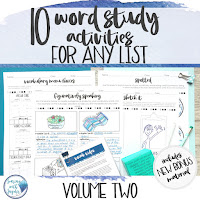
So far, I have FIVE separate volumes of nine activities created and ready to download and print. Each volume includes a table of contents and full-page student-friendly directions for each of the activities. They also include a choice menu for each volume, which allows students to make choices about which activities they work on to learn their vocabulary words each week. It is also a good tool to track completion of menu options depending on how long or how many options you allow students to complete. All three volumes also include a rubric, the "Map It Out" graphic organizer and nine vocabulary activities that can be used with any of your own vocabulary lists. Each volume of my Word Study Activities also has one or two FREE bonuses, from a formative assessment tool to a student activity proposal form to a pre-assessment and self-ratings scale. 


I also bundled these activities together for big savings. You'll get all five volumes (45 activities!) and the corresponding bonus resources for the price of four volumes!  If students complete one different activity a week, there are enough activities in the pack to last the entire year (or longer)! You can access the bundle by clicking the picture below.


Let me know if you have any questions! I love hearing from my readers! 


Signature
Back to Top