Showing posts with label differentiated instruction. Show all posts

Meaningful Word Work and Purposeful Practice--Six Ideas for Fun and Effective Vocabulary Instruction

Welcome (or welcome back) to another installment of my series on teaching vocabulary to gifted students. In previous posts, I wrote about steps to take before staring vocabulary instruction, including assessing what students already know using a quick and easy self-ratings scale. Next, I wrote about strategies for introducing new words and putting a gifted twist on vocabulary instruction.

The whole reason I started researching best practices in vocabulary started when I realized a few things.

  • One, I had gifted students to teach and it was obvious that the regular, run-of-the-mill vocabulary materials handed to me by the district would not be sufficient. 
  • Two, had the curriculum been challenging enough for my students, I found it dreadfully boring. If I found it boring, my students would have positively died. And I'm not into creating that kind of emergency in my classroom. 
  • And three, I knew the importance of vocabulary instruction and it's far-reaching effects, so it was something I felt I couldn't afford to get wrong. Thus began my own journey into deeper learning so that I could really make an impact in our classroom, while also injecting some FUN!

This post goes into a little more depth on the components of quality vocabulary instruction, as well as some of the activities that I used with students to engage them in meaningful word learning and purposeful practice. Just as a quick reminder, a child's vocabulary is a huuuuuuge predictor of academic success in ALL areas.

What the Research Says


One of the best-known researchers in the field of vocabulary instruction is Robert Marzano. In his studies, he found six key steps were the key to better vocabulary instruction. The first three steps are done with the help of the teacher:


  1. Teachers should give students an example, description, and/or explanation of the new term. 
  2. Students need to restate the explanation, description, or example using their own language.
  3. Students should construct a picture, pictograph, or symbolic representation of the term.

(If you hop back to my previous blog post, you will find a free download of a graphic organizer on which students can engage in steps two and three). 

 4.   Periodically, students should engage in activities that help them add to their knowledge of the terms in their vocabulary notebooks.

 5.   Students should be asked to discuss the terms with one another sometimes.

 6.   Students are periodically involved in playing games that enable them to play with terms.

In studies conducted with classrooms using these strategies, it became clear that when teachers engaged their students in alllll of these six practices, students usually showed significant gains in vocabulary learning. 

Other well-known vocabulary researchers, Dr. Kate Kinsella and Dr. Kevin Feldman, point out three things that don't work in their article, Narrowing the Language Gap: The Case for Explicit Vocabulary Instruction: "looking up words in the dictionary, using written context to determine word meaning, unplanned, extemporaneous vocabulary teaching."

Instead,  teachers should focus on four important ideas: wide reading, direct teaching of important individual words, teaching word learning strategies, and fostering word conscientiousness through various activities that encourage language play, and choice in writing (Graves, 2000) and (Nagy and Scott, 2000).

My General Flow of Vocabulary Instruction and Assessment 

Now that I've shown you some research, and told you a little about how I preassess and introduce the words, as well as how I accommodate gifted learners, I'm thinking you might be curious about how it all fit together for me.

A typical vocabulary cycle flows like this for me:

  1. Pre-test students on new words by having students complete a self-ratings-scale prior to starting a new list 
  2. Introduction of new words. If they already know any of the words well enough to define and use in a sentence, they don’t have to study those words. You can find more about how I pre-assess for vocabulary in this blog post.
  3. Students add their words to our  “Map It Out” cards. We discuss the definitions of the vocabulary words together. Students continue to work on these throughout the entire cycle, starting with the synonyms and antonyms (you can even do this part together) and reserving the sentence writing portion until near the end. The “Map It Out” cards are great for students to keep with them when they are working on the other learning activities throughout the cycle, too!  They can always go back to the cards and add to or revise them as they learn more about their words. You can read more about introducing the words and find a free download of the Map It Out cards here.
  4. Students add their words to a catalog or make word wall cards for each root or affix. The “Map It Out” cards themselves are sized to fit on a 5 x 7 notecard or in a composition notebook. I like students to keep a record of all of their words for the year to use for reference and as evidence of all the learning they’ve accomplished! 
  5. Students choose one to three (or more) learning activities (like the ones outlined below) to complete. *The number of activities chosen should be a reflection of how much time students have and the number of activities you think each student needs. Gifted students may require much less repetition than “typical” peers or students with other learning differences so the activities that go more in-depth may be a better fit for them!* 
  6. Use a quick-check strategy every couple of days to measure progress on learning. I do not use this as a graded quiz. It is meant to be a low-stakes, low-risk tool that students can use to quiz themselves as they are progressing toward mastery. This is a research-based strategy that has been shown to increase retention. 
  7. Assess student learning following the completion of the activities.

This cycle is flexible, but I found it generally took about 7 school days to get everything accomplished. Yours might take more or less time, depending on how much class time you can dedicate to it, and of course, on your students' needs. 

How I Encouraged Word Play in My Classroom

While I definitely engaged students in the super important pre-assessment and direct instruction activities, my FAVORITE part of the vocabulary learning process was definitely allowing students to engage in different activities that helped students achieve deep learning and understanding of their words. This was definitely the part my students enjoyed the most, too.

I'll outline a few of my favorite activities here, and maybe even provide a *free* download for you at the end.  

"WordTube"

This activity is a play on the popular YouTube website. Students write each assigned vocabulary word and draw a picture of it on a “WordTube” screen. Then they use the “Up Next” boxes to write the part of speech, identify the roots/affixes contained in the word or the origin if the word does not appear to have Greek or Latin roots or any affixes,  and define the word. Students should paraphrase the definition, as this strategy requires more critical thinking and will ultimately help them remember the meaning of the words better. 

Word Analogies

Students create their own analogies for vocabulary words. Creating and using analogies when learning new material is a research-based strategy that requires students to have a deeper understanding of vocabulary words, activates prior knowledge, and helps students bridge the gap between their schema and new learning. There are two ways students can use this strategy-- students can create their own analogies for vocabulary words and complete the entire analogy. Or,  students can create partial analogies that they can trade with a partner to solve. For this option, they must also make up an answer key (I suggest they create the answer key first). You'll want to be sure to teach children the different kinds of relationships you can create with analogies--for example, analogies can show part to whole relationships, the can reflect synonyms, antonyms, time sequences, increasing or decreasing intensity, etc. 

Shades of Meaning

For this activity, students generate semantic gradients for their vocabulary words. This requires them to think of or find words that are semantically similar to their vocabulary words and then to arrange the words in order. This activity helps students make meaningful connections between words they already know and their new term. There are, again, two variations of this activity that are fun and useful. For one variation, students would either think of, find (or be provided with) a list of synonyms that align with the original vocabulary word. They would then arrange the terms in order from the strongest expression of the term to words that express the term to a lesser degree.  

For the second variation of the activity, students think of or look up 5 synonyms and 5 antonyms for the vocabulary word. They place the vocabulary term in the center of the continuum and then arrange the synonyms and antonyms so that they get stronger as they move away from the center. When students are finished, they should discuss with someone why they chose to put their words in order. They could write their rationale instead if no-one is available to discuss. 

I like to allow students access to both options because some terms don’t really have opposites. Further, I always allow some flexibility with the number of synonyms and antonyms students have to find, as some wordsparticularly words from content area studiesdon’t have many synonyms or antonyms. Also, since these are fairly subjective and there is lots of “grey” area in terms of how the words are arranged, grading these should either be avoided, aside from completion, or rely heavily on the child’s explanations. I highly suggest this activity be completed with pairs or small groups of children to encourage the rich conversations that can occur as they are determining the order in which to place the words. 

Making Connections

Making connections between words really encourages students to think deeply about the meaning of words, and how they relate to other words. This activity is well-suited for small groups of students, as well as the entire class at once if you’re all studying the same words at the same time. 

Students are each assigned one or two unique words, and then they spend time interacting with others in an effort to find a word that they feel connects with their words. Eventually, students settle on a connection or match. Then, students explain either in writing, to the class, or just to the rest of their group members how their terms are connected. 


You will want to spend some time with your students discussing the difference between surface-level and deeper connections. For example, students need to look past words having the same number of letters, starting or ending with the same letters or sounds, being in the same chapter in their science book, etc. The activity (and related research) suggest that making deeper connections between words and concepts are really what will help cement the vocabulary into children’s learning, creating long-lasting, authentic learning experiences. 

Interview a Word

This activity is great for helping deepen students’ understanding of words and their possible connotations. One student “becomes” one of the words, and the other student is the interviewer. It
is fun to encourage the “words” to show their personality and act as though they were truly embodying their word. My students really enjoy acting things out like this! I suggest doing this activity in pairs or small groups, however, if a child is working independently, he or she can just write down the answers to the interview questions on paper instead of posing the questions for someone else to answer.

For this activity, you may find it useful to allow students access to websites such as visualthesaurus.com and www.etymonline.com so they can research some possible answers to the interview questions.

As a fun aside, having students make and wear nametags for this activity is a fun way to boost engagement!

Create a Menu

Students get full creative license over designing a menu for a new restaurant and using their vocabulary words in the descriptions. Students start by deciding on a theme and name for the restaurant. Then they decide the names of dishes to include on the menu, all fitting in with the designated theme.  Next, students use all of their vocabulary words to create a restaurant menu. 

In my opinion, it is not necessary that each menu item use a vocabulary word, as long as they have managed to include all of their words on the menu somehow, using them properly in context. 

Creating a themed restaurant and sticking to only including dishes that fit the theme definitely requires higher level thinking skills. If you find this to be too challenging for some of your students, you could allow them to include dishes on the menu that do not fit into a particular theme, as long as they are still using their vocabulary words to write the descriptions.  If you want to take this to the next level, you could do something like have students design and create an actual (miniature) restaurant storefront, or allow students time to visit each other’s restaurants and “order” something off of the menu. 


Sound like fun? 

There are SO many other great ideas for helping your students engage independently with their vocabulary word study. I put three of the above ideas together for you in a free exclusive download if you're ready to give them a try. This freebie is available ONLY to my subscribers and can be found among many other free resources in my free resource library.  Click the image below to gain access to your free copy! *Just to be clear, by clicking to get these freebies (and instant access to the growing collection of free resources in my library of subscriber exclusives), you're also agreeing to be added to my email list, where I'll send occasional messages with fresh ideas, tips, and other resources straight to your inbox. You can unsubscribe at any time.*


If you're ready to save TONS of time, you can find these three activities and many more in my store by clicking on the images below.

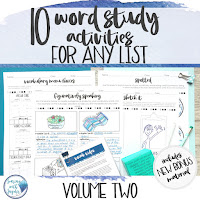
So far, I have FIVE separate volumes of nine activities created and ready to download and print. Each volume includes a table of contents and full-page student-friendly directions for each of the activities. They also include a choice menu for each volume, which allows students to make choices about which activities they work on to learn their vocabulary words each week. It is also a good tool to track completion of menu options depending on how long or how many options you allow students to complete. All three volumes also include a rubric, the "Map It Out" graphic organizer and nine vocabulary activities that can be used with any of your own vocabulary lists. Each volume of my Word Study Activities also has one or two FREE bonuses, from a formative assessment tool to a student activity proposal form to a pre-assessment and self-ratings scale. 


I also bundled these activities together for big savings. You'll get all five volumes (45 activities!) and the corresponding bonus resources for the price of four volumes!  If students complete one different activity a week, there are enough activities in the pack to last the entire year (or longer)! You can access the bundle by clicking the picture below.


Let me know if you have any questions! I love hearing from my readers! 


0


Signature

Help Your Advanced Reader: Eight Practical Ways to Find Great Books

Parents and teachers of gifted or advanced children, do these children sound familiar to you?

She has 14 books on her nightstand, seven at the foot of the bed, and probably two or three more under her pillow. She has surrounded herself with books for as long as you can remember.

He "sneaks" reading in at all times of the day, sometimes smuggling books into the smallest crevices and cracking them the tiniest bit open the moment he thinks you're not watching.

She's maxed out her library card allowance,  consumed multiple books from your own shelves, borrowed from friends and teachers, and is constantly on the hunt for more.

He devours each and every book he can find, often able to tune out many noises and other activities occurring in his surroundings. He would miss meals if you didn't remind him.

I know I've encountered these children both at home and at school. (In fact, there is a pretty good chance that I actually am one of those people ^^^.)

If you know (or live with) one of these voracious readers, you might find yourself thinking about what a blessing it is that your child or student reads so widely and deeply! After all, it is pretty awesome, right? Think of all the learning and imagining and growing your child is getting just from gobbling up all of those books!

If you know (or live with) one of these voracious readers, you are probably also familiar with what can feel like a never-ending struggle to find suitable reading materials. It's not always easy hunting down the next great read (or 826 reads) for your little (awesome) bookworm.

Today's post is aimed at helping point you to a few good places to look for the next reading treasure for your bookish child.

First Things First: Schools of Thought on What Kinds of Books are Best

There are several different ideologies about what gifted children should be reading. 

Guided reading gurus like Irene Fountas and Gay Su Pinnell have developed a system to match readers with leveled books. In a nutshell, they suggest that children be evaluated to determine what their instructional, independent, and frustration reading levels are. According to their research, they've found that children should tackle books that are deemed too difficult with for their current reading skills with extreme caution. If they can't understand 90-95 percent of the words on the page, their reading comprehension will suffer.  Instead, the authors suggest that children read books together with support from a parent or teacher that are at their instructional reading level, and save the books at their independent reading level to read on their own. 

Using reading levels is not isolated to guided reading. The advent of the Common Core State Standards brought with it the use of the Lexile system, which claims to match readers and books through the use of computer software. Critics of the Lexile system have noted that books like Fahrenheit 451 and Diary of a Wimpy Kid are listed at very similar levels, which calls into question the notion of whether the system is truly able to evaluate the complexity (and maturity
level) of the ideas presented in the books. 

There are other schools of thought that suggest children should have full autonomy over which books they read. Teachers and researchers like Nancie Atwell and Donalyn Miller have suggested that it doesn't necessarily matter whether the books are too easy or too hard for the child (within reason) as long as they are engaged in reading books that they actually want to read for extended periods of time each day. These behaviors reflect what it's like to be an adult reader, out in real life. According to Donalyn Miller, 

Providing students with the opportunity to choose their own books to read empowers and encourages them. It strengthens their self-confidence, rewards their interests, and promotes a positive attitude toward reading by valuing the reader and giving him or her a level of control. Readers without power to make their own choices are unmotivated. 

Critics of this thinking argue that children won't be growing as readers if they're spending time rereading Charlotte's Web for the seventh time or if they are toiling away at Moby Dick for weeks and weeks. * To be clear, I believe this characterization is a bit of an exaggeration of what choice reading proponents have laid out,  and not really reflective of my own concerns, but I thought it was worth noting.*

And then there are some people who think that children (advanced or not) should all just stick to the books that are marked as appropriate for their grade level/age. They say that advanced readers don't need advanced texts because they can "go deeper" with the regular grade level texts. Matching advanced readers to texts marked for students' current grade level can sometimes be a little more challenging, but can definitely work if you manage to find books that are more complex in structure, perspective, genre, or theme.

I tend to think that a combination of these approaches works best. Finding a balance between allowing choice, and guiding students to choose books that will help them grow as readers by stretching their decoding, reasoning, and reflection skills at the same time seems to be the best approach for me. Further, whichever approach you prefer, for gifted readers, it is important to find books that have rich language, complex but relatable characters, and intricate plots to satisfy their needs and help them grow.

No matter which of these ideologies seem to match your reader's needs (and your own thinking) best, the problem remains: how can I find books that will work for my kid?!

Some Practical Ways to Find Books That Fit

Below is a compilation (in no particular order) of strategies and resources I use when trying to help match readers to books. This list stems from my experience teaching gifted readers starting in kindergarten through 5th grade as well as from having my own advanced readers at home. None of these recommendations are part of any kind of affiliate program--I won't get money if you choose to purchase anything after reading the recommendations. I'm suggesting them to you because they are what worked for me as a gifted intervention specialist and parent. 

  • Picture books--I think these are an often undervalued resource. Kids (and adults alike) think that once they are fluent readers, chapter books and novels are the only way to go. And while using those longer books certainly provide a little more respite in between searches, picture books can provide really rich opportunities for exposure to advanced themes, vocabulary, and structures that may be too difficult for readers to access in the longer stories.   Authors like Patricia Polacco, Jan Brett, Bill Peet, Graeme Base, Chris Van Allsburg, Steven Kellogg, Mark Teague and Tomie DePaola are some of my go-to picture book authors. 

  • Graphic novels--Despite what you may be thinking, these books are so much more than long form comic books!  A lesson plan on the Scholastic Teachers website called A Guide to Using Graphic Novels with Children and Teens notes:
The excellent graphic novels available today are linguistically appropriate reading material demanding many of the same skills that are needed to understand traditional works of prose fiction. Often they actually contain more advanced vocabulary than traditional books at the same age/grade/interest level. They require readers to be actively engaged in the process of decoding and comprehending a range of literary devices, including narrative structures, metaphor and symbolism, point of view, and the use of puns and alliteration, intertextuality, and inference. Reading graphic novels can help students develop the critical skills necessary to read more challenging works, including the classics.

  • Children's Classics/Books Written Long Ago-- I love using classics and older books with advanced readers for several reasons. One of the biggest reasons I frequently recommend them is that the content in them is often less questionable than some of the modern-day books written at the same level.  Also, the language in some of the books written long ago is not commonplace in our everyday speech, so comprehending the texts definitely takes more effort on the reader's part. And, despite what Mark Twain may have said about classics, these books can be entertaining and fun for children to read. My daughters loved Pollyanna, The Velveteen Rabbit, Alice in Wonderland, Anne of Green Gables, Charlotte's Web, The Secret Garden, Aesop's Fables,  Mother Goose Stories, and others. 

  • Literary Magazines--These were always a hit in my upper elementary classroom. I love them because they include a nice variety of genres like poetry and nonfiction that children may not always go about choosing on their own. They are also often illustrated, and sometimes include fun writing contests that help motivate some children to compete! There are many options for these magazines, but my favorites are from Cricket Media (not an affiliate link,  I just LOVE these magazines). Titles like Spider, Cricket, Muse, Calliope, Odyssey, and Cobblestone were always student favorites. There are other options available, like Scholastic's StoryWorks Magazine, however, I found them to be too simple for my advanced readers, beyond perhaps some of the comprehension skills practice they offered. 
  • Project Gutenberg--This site has a collection of over 54,000 FREE ebooks! One really nice feature is that they don't require registration, so using it in school (or at home) is a breeze. They also offer several different ebook formats,  so you have some flexibility in how you access the books. On the site, you can click on a tab labeled "Book Categories," which will lead you to many different groupings of books, including children's books and classics.  You still have to know what you're looking for, of course, which leads me to my next recommendation:


  • Some of My Best Friends Are Books: Guiding Gifted Readers, by Judith Wynn Halstead-- This is a book I've had in my collection for many years. Now in its third edition, this title describes the intellectual and emotional needs of gifted readers, provides a framework for typical reading development, and offers advice for parents and teachers of gifted children in guiding their young gifted readers in choosing and understanding books. It also has an annotated book list of over 300(!) books divided into both age groupings and listed under intellectual and emotional topics or themes such as intensity, introversion, developing imagination, sensitivity, and resiliency, among many others. It is truly a wonderful book that I recommend anyone who works with gifted children add to their library. 

  • Librarians--Meet them, greet them, bake cookies for them, and treat them well. They are one of the most powerful and resources we have on our journey to find great books. I had one school librarian, in particular, that would just scour the ends of the earth with me to try and find books that were just right for my advanced readers. One note of caution--not all librarians are fans of allowing children to read out-of-level books. To this I say you can thank them for their input. If you want to, you can also gently let them know that according to your own research and the knowledge you have of your own student or child, you believe reading X, Y, or Z types or levels of books is the best option at this point. Feel free to give them my email address if they have questions.  ;) 

  • Use Websites and Facebook Groups for more recommendations--Other parents and teachers of gifted people are almost ALWAYS willing to share with you the books that worked for their children or students. The book lists section under the kids/teens section on Hoagie's Gifted website has TONS of annotated books lists for many topics like Classic Fiction, Girls and Young Women, Math and Programming, Mystery, Puzzle Books, Books about being Gifted, Arts and Crafts, and many more. On Facebook, search for groups or pages operated by your local gifted associations or larger groups like the NAGC or Hoagies' Gifted Education Page. In those groups, parents are encouraged to share experiences, ask questions, and give recommendations to one another. 

A Few More Tips


DO... 

...read out of level books before/with your children when possible. If you can't do that, try checking out the Common Sense Media website for information about the content and language in the book.

...check the lists of reviewed books from district, state, and national sites. Here are a few of the good sites I've come across:
Recommended Books for Talented Readers
Book List for Elementary Gifted Students
Minnesota Council for the Gifted and Talented: Books for Young Readers
Good Books for Verbally Talented Readers


...send out a permission slip for out-of-level books if you are a teacher. You can see the one I created here. 

...use technology to your advantage. From the lists upon lists that I've referenced above to the ability to check out books online from your local library to download your child's device, the sky is the limit when finding books that your young advanced reader will love!

DON'T...

...assume your values match those of your student's families and limit or encourage above-level texts accordingly. This is why sending a permission slip can be so helpful! It removes the responsibility of judgment from your shoulders and allows parents/guardians to decide.  

...limit kid's consumption of texts to only their "Zone of Proximal Development"/Reading Level/Lexile Level. There are so many factors that influence a child's ability to comprehend text. Motivation to read the text plays a HUGE role in the child's ability to stay with the story and work at comprehending it. 

...assume one size fits all. Among the group of children in a single grade level who are considered advanced readers, there can still be an enormous range of reading abilities and interests. Just because the book works for one child doesn't mean it will work for all children.

Do You Have Any Other Great Resources?

Leave me a comment below or connect with me on Facebook and let me know what tips you have for finding great books for your gifted or advanced readers! 


SaveSave
0


Signature

Meeting the Needs of Gifted Learners: Differentiating the Learning Environment 6/6


Welcome to the final post in my series on differentiation! It's been quite a journey, so thank you if you've stuck around long enough to see it through! You can catch up on other posts like my overview of differentiation, found here. To read about pre-assessment, click here. You can also read ideas about differentiating content, process or product, and take a peek into how it worked in my classroom here. Today's post is about differentiating the learning environment for gifted students.

Differentiating the Learning Environment

Creating a Safe and Supportive Learning Environment for Gifted StudentsOk, so it seems a little funny to be sitting here writing about how teachers and parents can differentiate the learning environment for gifted children because, in all reality, most of the things I'll be writing about are truly practices and ideas that all students would benefit from encountering. If you have a gifted child in your classroom, I would consider the following ideas to be great pretty much imperative. If you don't have a gifted child in your classroom, I still believe you would agree with me that integrating the suggestions below would still be a best practice for any of the "typical" learners in your classroom. 

Differentiating the learning environment for gifted students encompasses not only the physical space in the classroom, but also how students are allowed to move about during their time in the classroom, and the social and emotional learning conditions in which children are learning. 

Setting up the Physical Space for your Gifted Learners 

Meeting the needs of the gifted and talented children in your classroom typically requires some space set aside for the student(s) to work independently, in pairs, or in small groups. Providing some sort of space for you and students to meet either individually or in small groups should also be part of the plan. In my classrooms, I had several areas that would work in these capacities.

First, I always had student desks in some sort of groups. This worked well for me because of the way I structured my daily math and language arts routines, but it also allowed for me to join students at their desks so that I could easily help problem solve as needed. Please note: my classroom's physical environment was nothing compared to the rooms I saw when I visited places like The Roeper School in Bloomfield Hills, Michigan, which is a private school serving gifted children in the suburbs of Detroit. However, I do think it worked well for what I needed it to do! (Read: It was never Pinterest-worthy, but I liked it well enough!)

Classroom Learning Environment Picture Students desk groupings

In my lower grade classrooms when I taught guided reading, I also always had a kidney bean-shaped table. It was perfect for small group instruction but also doubled as a place on which students could complete projects or work independently. In my upper elementary classroom, I didn't have a kidney table available, but I did have a couple of areas in which I met with students in small groups or independently. Most often we conferred near my teacher desk where I set up a little area for with supplies for reading conferences and meetings for "Genius Hour" projects or independent learning contracts. We also met on the floor in my classroom library. The library was definitely the most frequently used space in the classroom, and it filled many purposes each day.

Classroom Library and Meeting Area

Speaking of classroom libraries...You should definitely have one--especially if you're teaching gifted children. It should contain a selection of interesting reference materials, high-quality literature, books from as many genres as possible, written on a wide range of reading levels. This picture was taken before school started after I was almost finished labeling and loading in all of my books into my new upper elementary classroom when I first started teaching at this particular school. You can't see everything, but I did my best to stock the library with hundreds and hundreds of books. I had everything from picture books to classic novels. I had books written in languages other than English, reference books, pop-up books, comic books and graphic novels, and so many others.

In addition to these spaces, having an area designated for technology use is important so students are able to conduct research, complete assessments, work on technology-based or tech-enhanced projects.

The classroom should also have enough space so that students can easily transition from one area and work-style to another. Students should be able to move freely in and out of whole-group, small group, and independent work.

 I also found it important to make sure that students had easy access to a variety of supplies and materials needed for the various projects they were working on. In my lower elementary classroom, I had an art center with many supplies readily available. I was able to control which supplies students had access to during their independent work time by only putting out what they were allowed to access and keeping the rest of it in the cabinet. In the upper elementary classroom, I allowed students full access to the shelves in a large supply cabinet of mine so that they could access anything they needed when they needed it. It almost goes without saying that I spent a significant amount of time at the beginning of each school year teaching students how to access, use, and properly clean up after themselves. Our mantra was a favorite quote of mine from Eleanor Roosevelt, "With freedom comes responsibility."

I also had some spaces dedicated to learning stations/centers (like a listening center, a writing center, and an art center for lower elementary) but for the most part, I stored center materials in bins which children could take wherever they wanted in the classroom to work.

So I had all of these spaces in my classroom and I pretty much let students work wherever they wanted to most of the time. I differentiated the seating arrangements by allowing student choice. Allowing students to work at the location where they were most comfortable in the classroom was the way I preferred it, and I think students appreciated it as well. "Flexible seating" is the buzzword for varied seating options in the classroom, so if you're looking to learn more about this, a simple google search will yield many results of how other teachers implement versions of this idea in their classrooms.

Creating a Safe Social and Emotional Space for Gifted Learners 


Although I took pride in the physical environment and day to day workflow in my classroom, this part of setting up the classroom environment for social and emotional student safety and success was truly a top priority for me. One of my biggest goals as an educator was to create an atmosphere in which gifted children felt safe, felt loved, felt appreciated, and felt like they could truly let loose and be true to themselves. I knew that these children came to me with their special package of gifted traits, and I knew that sometimes those traits had the potential to drive teachers (and other adults with whom they interacted) up. a. wall. Moment of full transparency: sometimes those same traits they threatened to drive me straight into the looney bin too, but because I knew that these kids needed a space where they could be themselves, I was usually able to get off the road to crazy one or two exits before total insanity. All kidding aside, we worked hard as a classroom community to develop a set of standards for behavior, attitude, work ethic, and community spirit that made our time together truly special. And I do think that together we achieved a place for students to be safe, to be heard, and a place just to be.

Here are some of the things I implemented to help create this environment:

    Quote from article
  • Set expectations early, set them clearly, and set them high. We spent lots of time at the beginning of the year discussing, modeling, crafting guidelines together, and acting out scenarios for how to deal with daily interactions and conflicts in the classroom. And then we did it again. And again. Aaaaand again. And then sometimes we let some time go by and things were perfect we kept practicing.
  • Because gifted students have a tendency toward a heightened sense of justice and equality, I included frequent dialogue about the fact that fair was not a synonym for equal. This was important especially for my upper elementary students who came to me only for part of each day. They reported hearing other students expressing jealousy that they got to leave the classroom and go to "the fun teacher" (btw, of course, this was completely TRUE-I was a fun teacher 😜 ). Seriously, though, hearing others say this to them sometimes hurt their feelings or made them feel more isolated because they already knew they were a little different from those other kids--they didn't need a reminder that they had accommodations in their day that made them stand out even more. So, when they got to me, I reminded them that it wasn't about coming to "the fun teacher," it was about getting more of what they needed to help them learn and grow as students. 
  • My classroom was established as an absolutely, positively, bully free zone. Gifted children are already prone to being victims of bullying because of some of those same gifted traits that make them special (one recent study I read mentioned that between 60 and 90 percent of gifted children had been bullied at one or more points in their school careers). Being bullied puts children at risk for underachievement, decreased confidence and view of self-worth, anxiety, and depression, which can lead eventually to eating disorders, chemical abuse, higher dropout rates, and other potentially devastating results. 
  • Created an atmosphere of acceptance and appreciation for some of the quirky things that come tied up in the gifted "package." Whenever possible, we laughed at our own weird sense of humor, we celebrated each other's curiosity (I had a "Wonder Wall" and we worked weekly on self-selected inquiry projects), and we navigated our way through the intensities children had by using a variety of strategies and tools. 
  • Developed a sense of perpetual learning and growth. I tried really hard to be sure to create an environment where students were praised for the effort they put into their work, while simultaneously trying to kind of devalue the focus on grades/achievement. Of course, I wanted them to get good grades, but it was more important for me to convey to them that it was important to keep working hard, no matter what grades they got. I wanted them to understand that it didn't matter whether they got and C or an A on that assignment because the learning wasn't DONE! If they got a C or lower, I allowed them to make a plan for fixing up mistakes or misunderstandings, or for learning the things that they hadn't learned yet. If they got an A or a B, it was important to look at the goals we'd set and decide whether to reevaluate and set some higher (or different) goals for next time. I highly recommend reading the work of psychologist Carol Dweck and her Growth Mindset approach if you want to learn more. She has a really great TED talk that you can listen to here
  • Established a strong sense of community. I was lucky enough to be introduced to Responsive Classroom when I taught in my self-contained gifted kindergarten classroom. I read and received some training and then once I started, I never looked back. I'm not an affiliate in any way, but I am a big proponent of the methods developed by the authors of this approach. The basic tenets of their program are these (taken directly from their website):

    • Engaging Academics-Teachers create learning tasks that are active, interactive, appropriately challenging, purposeful, and connected to students' interests.
    • Positive Community-Teachers nurture a sense of belonging, significance, and emotional safety so that students feel comfortable taking risks and working with a variety of peers.
    • Effective Management-Teachers create a calm, orderly environment that promotes autonomy and allows students to focus on learning.
    • Developmental Awareness-Teachers use knowledge of child development, along with observations of students, to create a developmentally appropriate learning environment. 


    The books pictured below became some of my most referred-to books (as you can probably see by the 5,621 sticky notes sprouting out from the tops and sides). A big part of the program was having class meetings in which students really had time to get to know one another, cheer for successes, empathize with problems, and develop genuine relationships with one another. We ALL looked forward to those meetings. 
Responsive Classroom Books "The First Six Weeks of School" and "The Morning Meeting Book"

I hope you find these ideas and strategies helpful! I'd love to hear about the ways you encourage a positive learning community in your classroom-- I'm always looking for new ideas. And since you made it to the verrrrry bottom of the post, I'm going to leave you with two handy freebies that I hope you can use in your journey. 

But before that... I'm excited to finish this series and I have lots and lots of ideas for new posts, but I would LOVE to hear about ideas or questions you have that you'd like me to explore in a future post! If you have any thoughts, you can scrollllll on down to the bottom and leave a comment, you can email me at jen@soaringwithsnyder.com, or you can reach out to me on any of my social media platforms by using the links on the top of my website or by searching Soaring with Snyder on Instagram, Facebook, or Twitter. I hope to hear from you!

Click the picture below to get access to a free cheat sheet  that I created about gifted overexcitabilities. These OEs are common among gifted people, and knowing about them can help you create an even safer environment for gifted students.  *Just to be clear, by clicking to get these freebies (and instant access to the growing collection of free resources in my library of subscriber exclusives), you're also agreeing to be added to my email list, where I'll send occasional messages with fresh ideas, tips, and other resources straight to your inbox. You can unsubscribe at any time.*


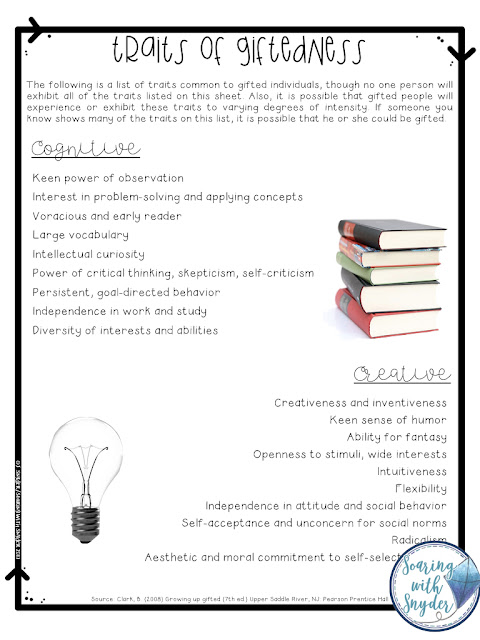
And here is a list of characteristics common to gifted children that you may find helpful in your planning as well. 

List of Gifted Traits

Finally, here are some of the sources I used or referenced in the creation of this post if you're interested in digging a little deeper...

http://www.purdue.edu/uns/html4ever/2006/060406.Peterson.bullies.html
http://sengifted.org/trauma-a-call-for-collaboration/
http://sengifted.org/gifted-kids-at-risk-whos-listening/
https://st-clair.net/Data/Sites/1/media/public/SpecialEd/gifted-program/differentiation-and-enrichment-strategies-for-gifted-students.pdf
https://daretodifferentiate.wikispaces.com/file/view/The+Learning+Environment_+Meeting+the+Needs+of+Gifted+Students.pdf
http://summitcenter.us/wp-content/uploads/2012/07/GiftedandBullied_GEC_Spr2012.pdf


Thanks, friends.
0


Signature

Meeting the Needs of Gifted Learners: Differentiating Products 5/6

Welcome! This post is the fifth (well, technically the sixth!) post in a series I've dedicated to writing about how teachers can differentiate for students in the classroom. If you'd like to read an overview of differentiation, click here. If you would like to read about pre-assessment, differentiating content, differentiating process, or to see a snapshot of how it looked in my classroom, use the words above or the sidebar to navigate to my other posts.

Today's post is all about differentiating the products that your students complete as part of their learning journey. I'll define it for you, give you some important tips, show you an example of how I did this in my gifted classroom, and I'll even give you a list of ideas you can use in your own classroom.

What Does it Mean to Differentiate Products? 

A product is what students do or make with their newly acquired learning. Products help children think
about and extend their learning. It's something that happens at the end of a lesson unit, month, semester, or even entire year of learning. It can be something as simple as having students compose a poem that reflects their learning, or compiling a portfolio of different assignments, or it can be something as complex as a student-created simulation or documentary. Products allow the teacher to assess student learning.  Products are also quite powerful tools for students to really demonstrate their understanding because they remove some of the barriers put up by traditional paper and pencil assessments. If teachers are looking to truly measure a child's science knowledge, they can devise a way to measure truly that, and not whether students have writing and organizational skills to construct a five-paragraph essay.

Differentiating the products that students produce means that they have access to completing DIFFERENT activities or projects following their learning. They complete these tasks or assignments on their own or in small groups, which allows for independence, variety, choice, and challenge. It also allows for teachers to teach the same content to their class (especially in schools where teachers are required to stay within certain grade bands/knowledge strands) while allowing for the application and synthesis of the knowledge to be expanded within the creation of the products.

An Example of How I Differentiated 

To help illustrate how you can differentiate products in your classroom, I'll give you an example from my classroom. One way I regularly incorporated product choice in my upper elementary gifted classroom was in my bi-weekly word study/vocabulary instruction. My vocabulary study for 4th and 5th graders was based on Greek and Latin roots, prefixes, and suffixes. 

  1. At the beginning of each new two-week cycle, the class and I held discussions about the new roots, prefixes, and suffixes. Students made predictions about the word parts, based on their schema, and clues from words containing the Greek and Latin morphemes. 
  2. Then, we looked at a list of about 20 words that I had provided them, and children rated their knowledge of the words using a stop-light color-coding system. Words that they already knew and could teach to others were coded green and less familiar words were coded yellow (they've heard of the word and/or have seen it, but couldn't really use it in a sentence or explain it well) or red (they had little or no idea what the word meant). The red- and yellow-coded words became their word study words for the two weeks. Occasionally, I selected one or two "must-do" words, especially if they were relevant to a unit of study or if they were mandated terms for students to know. 
  3. We met in small groups to learn more about the meaning of the words and then added them to our word-study journals, with a sketch and/or Frayer model for each unknown word.
  4. Finally, students used the red- and yellow coded words to create a variety of products. At the end of the cycle, we had product presentations. Students looked forward to presenting their products to the class, and it became a really fun bonding time and learning experience for everyone. 
You can see a couple of small examples of student work in the photos below. This is a little script from a mini-play. 

Water Words Word Study Product Choice
                         
And pictured  below is one slide from a slideshow story a student had written incorporating her words.

Bob's Bedroom Word Study Vocabulary Story

Sidenote: 

When I first introduced the product choices to students, I was careful to model for them and show them clearly the expectations for each product choice. The only time I did not do this was when a student had their own idea for a product. For these occasions, I worked one-on-one with the student to develop the criteria for the content, quality, and creativity of the product.

We also spent quite a bit of time for the first several cycles getting out the rubric that would determine their grade, and comparing the work they had done to the rubric. We carefully examined each section of the rubric and determined the meaning of the indicators for content, quality, and creativity, giving examples AND non-examples of what each indicator meant. 

Somewhat unrelated, but I'm guessing that you may be thinking that I was extremely trusting of my students, allowing them to self-select their word study words. The reality is, you're right. I was very trusting of students to choose the words on their own, but it doesn't mean that I didn't ever question them on their choices, or double check their lists while they were working. Again, all of this was a combination of the process of me getting to know my students very well (I did loop with them for up to three years at one point!), some spot-checking on occasion, some informal pretesting, and some honest-to-goodness faith in my students that they could and would do the right thing. I had very few instances of anyone trying to "game the system" and if I had, I would have modified the selection process to include some formal pretesting of the words. 

Some Important Notes About Differentiating Products...

  • You should definitely allow for choice. The choice could be as narrow among just a few pre-planned options that you have for them, 
  • Be sure to set clear expectations around the content, quality, and creativity/originality of the products. I have a rubric that works for many product choices here if you're interested in taking a peek. 
  • Be sure that you and your students agree on a timeline for the entire process, as well as check-in points along the way. No matter what the age of your students, it will be helpful for them if you provide some scaffolding here. Obviously, how much scaffolding you provide should be adjusted according to your students' readiness. At the very least, I suggest having check-ins and/or deadlines for idea generation and selection, storyboarding or planning, creating, revising/editing, rehearsal (if needed), and final turn-in. 
  • Products can be differentiated by readiness, interest, and learning profile, or some combination of the three. 
  • Students might need coaching with certain procedural aspects of the choices they make for their products. For example, if a student chooses to create a video documentary or stop-motion film, they may need some assistance with the technical aspects of making the films. This is a great time to bring in outside experts--parents, community members, even other professionals in your school who can assist your students with these needs. Children can also do some research (another great learning opportunity)! 
  • Using differentiated products in your classroom is a great way to build classroom community. I often set time aside in class for students to share what they had been working on with the rest of the class. Sometimes, we even ventured out to share with other classrooms in the building, too! 
  • Inviting parents in for product presentations is also an excellent way to share products with a larger audience. Research has shown that student engagement and achievement rises significantly when students know that people other than just their teacher will see their work. 
  • Keep in mind, though, that not every student needs to (or wants to) share his or her product every time! This is not only time consuming, but for children uncomfortable in front of the class, it can be a source of unnecessary stress. 

Some Ideas for You

Sometimes the hardest part is getting started, right? I've created several ready-made resources that include product choices in my Teachers Pay Teachers store that you can find here. This is a growing collection of choices for upper and lower elementary students. And to thank you for reading allllll the way down to here, I made a list of many of the product ideas that maybe you'd like to try out. Click on the picture below to download your own free copy of the list from my free resource library. *Just to be clear, by clicking to get the freebie (and instant access to the growing collection of free resources in my library of subscriber exclusives), you're also agreeing to be added to my email list, where I'll send occasional messages with fresh ideas, tips, and other resources straight to your inbox. You can unsubscribe at any time.*

Thank you so much for reading! 

Ready to learn about differentiating the learning environment? Click here! Thanks so much for reading!
2


Signature

Meeting the Needs of Gifted Learners: Differentiating the Learning Process 4/6


When you choose to change, adapt, or otherwise make different the ways in which students gain access to new information or the way they process or learn new ideas, skills, and content, you're differentiating by process.  This is the fourth installment of my series on differentiated instruction. If you're interested in reading more about the whole process of differentiation, you can read about the definition of differentiation, pre-assessment, differentiating content, and how a differentiated classroom works, in previous posts.

What Does it Mean to Differentiate the Process?


Differentiating the process for learners usually translates to changing the activity part of the learning process or lesson. It is often the verb part of your learning objectives; whatever students do to move from their current understanding to deeper, more thorough, more complex levels of understanding. The need to differentiate the process for your students can often stem from a student's readiness, either in the area in which you're planning to differentiate or in another area. It can also result from the need to differentiate due to a learning disability in a student with dual exceptionalities. Your student with a disability in reading comprehension may be gifted in science and already know most of what you're planning to present in your rocks and minerals unit, but it will be difficult for him or her to access the information he or she needs to learn in a traditional textbook. When you differentiate the process for learning, you allow this student to have the same (or even more) information delivered to them in a different way. It might also mean that you allow them to interact with the information as part of their learning in a way that is different than their "typically developing" peers.

It is important to note that pre-assessment again plays a crucial role in using this strategy with fidelity. We have to have a solid grasp on what our students know (and don't know), as well as their strengths and weaknesses to plan effectively.

Framework for Differentiating the Learning Process

There are a few key ideas we can keep in mind as we plan and prepare to differentiate the learning process.

In her book, How to Differentiate Instruction in Mixed-Ability Classrooms (2001), Carol Ann Tomlinson gives ideas for increasing the complexity of learning activities. They include moving from concrete ideas to more abstract, starting at simple and moving toward more complexity, beginning with more structure and moving toward open-ended tasks or ideas, and moving from examining a single facet to looking at multiple facets of ideas or concepts.

Of course using Bloom's Taxonomy is another way to think about how we can create different learning activities that move students from lower order learning skills to higher order thinking. We can move them from simply remembering, understanding, and applying, to the more complex and intertwined analyzing, evaluating, and creating.

Using Dr. Sandra Kaplan's Depth and Complexity tools is another way we can plan for differentiated learning processes. You can read more about these visual prompts associated with deeper levels of critical thinking here.

Examples of Vehicles for Differentiating the Learning Process

Below you'll find just a few ideas for strategies or structures you can use in your classroom to help with the process of differentiation. This by no means is an exhaustive list, however, maybe it will help get you thinking about how many things you may already do that are headed in the direction of differentiation. Click on the picture to get access to your free printable copy. *Just to be clear, by clicking to get the freebie (and instant access to the growing collection of free resources in my library of subscriber exclusives), you're also agreeing to be added to my email list, where I'll send occasional messages with fresh ideas, tips, and other resources straight to your inbox. You can unsubscribe at any time.* 


A Couple of Examples in the Classroom 

Perhaps your students are learning some new content in the classroom about Native Americans. In one scenario, students might take out their social studies textbooks (all written on the same reading level and all containing the same information, of course). They listen to your voice while you read aloud, or they read the text to themselves, with or without your support. Not only does this sound pretty boring, but it also doesn't take into account the differences in the ways students in your classroom learn best. Aside from not engaging your students much in the learning process, you may also be inadvertently creating an environment where students will begin entertaining themselves in various ways, otherwise disrupting your plans for a peaceful learning experience. If you differentiated this process for your students, you could both increase student engagement and tighten up your classroom management. So, instead of assigning the reading from the textbook, perhaps you could work with your librarian to find a variety of informational texts written at various reading levels so students could access the information at their independent reading levels. Maybe you could also research (or again, work with your fabulous, indispensable local or school librarian) for some multimedia presentations of the information, some kid-friendly websites, some audio recordings, or even some local professionals who could deliver the information in a different way. This way, all of your students are gaining the information that you need them to learn, but they're just approaching it a from different angles. You can use these materials as part of your small group instruction (learn more about planning for small groups here), as part of an independent learning contract, or in some other way. The point is, not everyone has to do it the same way, in lockstep. We don't all learn the same way. It's just not the way we're made! 

Maybe it's your language arts class and the students are working on identifying character traits. You can differentiate the process by tiering the learning assignments. Let's say the learning objective is for students to choose two characters from whatever story they're reading currently and identify key character traits for those two characters. The tiers could look like this:
  • Tier One (below or approaching the standard): Use a graphic organizer to identify two main characters, note behaviors, actions, and thoughts from these two characters, and then draw inferences about their traits based on the text evidence they've recorded on their graphic organizer.  
  • Tier Two (at standard): Use a Venn Diagram to compare two (or three) characters from the text, using text-based evidence to support the claims of similarity and differences.
  • Tier Three (exceeds grade level standards): List characteristics displayed by two or three characters from the text. Rank the characteristics in order from most important to least important (or even have students decide upon which criteria to use in ranking the characteristics). 
If you look closely at the tiers above, you'll see that I used Bloom's Taxonomy to make slight changes from one tier to another. Tier one is pretty much remembering/understanding, tier two is more like applying/analyzing, and tier three is analyzing/evaluating. Please note--it is not appropriate to ONLY have your tier one kiddos staying that remember/understand level. They need to be practicing higher order thinking skills as well--this is how they'll grow best! At the same time, your tier two and three kids will also need to spend some time in the lower levels of Blooms sometimes as well, but the amount of time spent understanding and remembering as opposed to the analyzing/evaluating/creating levels should be considerably less

Well, you made it. You're at the end of another post. I hope you found this information helpful, and perhaps you'll consider stopping back to my little corner of the interwebs for the last two installments of the differentiation series. For those of you inspired to tackle one of the learning strategies I mentioned above, I created a FREE Independent Learning Contract for you to use. Click on the image below to download your free copy. *Just to be clear, by clicking to get the freebie (and instant access to the growing collection of free resources in my library of subscriber exclusives), you're also agreeing to be added to my email list, where I'll send occasional messages with fresh ideas, tips, and other resources straight to your inbox. You can unsubscribe at any time.*

And if you're looking for some activities that are already differentiated and ready to go, hop over to my store on Teachers Pay Teachers. I have a small (but growing) collection of materials for you to use in your classroom. 


Thanks so much for reading! Be sure to check out the next post in the series: Differentiating Products
0


Signature
Back to Top